California State University, Northridge has earned the 2026 Carnegie Community Engagement Classification, an elective designation awarded by the American Council on Education and the Carnegie Foundation for the Advancement of Teaching that highlights an institution’s commitment to community engagement.
“Community engagement is central to who we are as an institution,” said CSUN President Erika D. Beck. “This well-earned classification is a testament to the tremendous leadership of our faculty, in collaboration with staff and the Office of Community Engagement, in fostering impactful community partnerships that improve lives and strengthen communities and offer students’ hands-on, real-world service-learning experiences.”
CSUN is one of more than 230 colleges and universities from across the country to receive the honor. The institutions earning the designation demonstrated an “alignment among campus mission, culture, leadership, resources and practices that support dynamic and noteworthy community engagement,” according to an announcement about the classification. This is CSUN’s second consecutive designation.
Timothy F.C. Knowles, president of the Carnegie Foundation, noted that higher education “is a vital economic engine” for the country.
“Our colleges and universities not only fuel science and innovation, they build prosperity in rural, urban and suburban communities nationwide,” Knowles said. “We celebrate each of these institutions, particularly their dedication in partnering with their neighbors — fostering civic engagement, building useable knowledge, and catalyzing real world learning experiences for students.”
CSUN’s Office of Community Engagement supports the university’s mission to cultivate civic responsibility among students, faculty and staff by facilitating community-based (service) learning classes, promoting co-curricular engagement activities, implementing community-based research, and fostering equitable, reciprocal and sustainable community partnerships and projects within the San Fernando Valley, the greater Los Angeles area, and beyond.
Hundreds of classes, centers and institutes across the university have incorporated community engagement into their curriculum and projects. For example, students — regardless of major — provide free tax assistance to low-income taxpayers in Los Angeles County through CSUN’s Volunteer Income Tax Assistance (VITA) program.
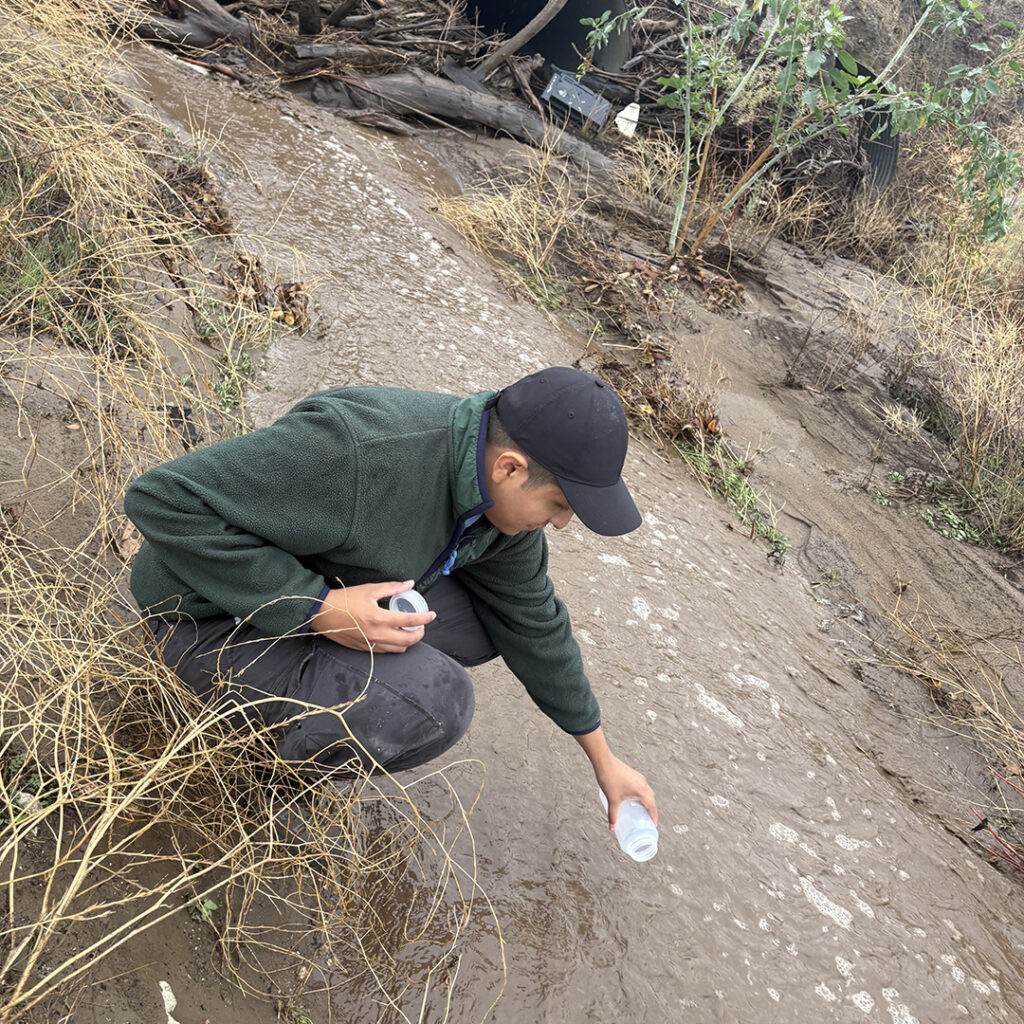
Geography and environmental studies students are measuring water quality in last year’s burn areas to lay the groundwork for a national database to help researchers better understand the impact the 2025 fires had on critical environmental characteristics, such as water turbidity. The database will serve as a baseline of information that can be used for future research.
Students with CSUN’s Family Kitchen have been teaming up with the U.S. Department of Agriculture’s Special Supplemental Nutrition Program for Women, Infants and Children (WIC) to enhance the amount of money that working class families can spend on fruits and vegetables at farmers markets in Ventura County.
The Community Engagement Classification is awarded following a process of self-study by each institution. The classification has been the leading framework for institutional assessment and recognition of community engagement in U.S. higher education for the past 19 years, with classification cycles in 2006, 2008, 2010, 2015, 2020, 2024 and now 2026.
In the 2026 cycle, 237 institutions earned the classification, joining 40 institutions classified in 2024, for a total of 277 institutions that currently hold the designation. The 2026 cohort includes a diverse range of colleges and universities, with 157 public institutions, 80 private colleges and universities and 81 Minority Serving Institutions represented among the recipients. The 2026 designation is valid until 2032, at which time the institution will need to seek reclassification to retain its status.
“The institutions receiving the 2026 Community Engagement Classification exemplify American higher education’s commitment to the greater good,” said ACE President Ted Mitchell. “The beneficiaries of this unflagging dedication to public purpose missions are their students, their teaching and research enterprises, and their wider communities.”
Like this:
Like Loading...
Related



 Tweet This
 Facebook
 Digg This
 Bookmark
 Stumble
 RSS
RSS



0 Comments
You can be the first one to leave a comment.