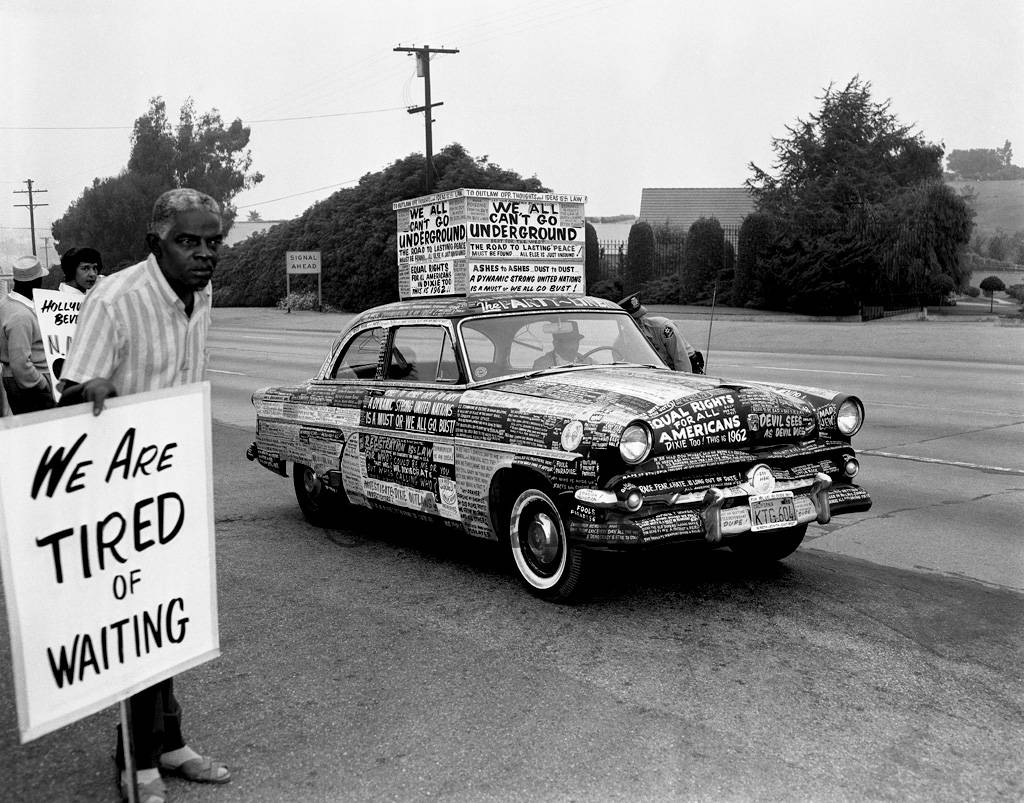
The black-and-white image is simple, but powerful. A man is holding a sign “We Are Tired of Waiting” while standing next to a car covered with slogans advocating equal rights for “all Americans.”
The photograph taken in 1962 by acclaimed Black photographer Harry Adams is one of several images on loan from California State University, Northridge’s Tom & Ethel Bradley Center that are part of the newest exhibition opening Tuesday, Feb. 24, at the Getty Museum. The show, “Photography and the Black Arts Movement, 1955-1985,” features African American and Afro-Atlantic diaspora artists whose work celebrated Black culture and advanced the struggle for civil rights.
“Photography is an art form, though some people consider it the stepchild of the art world,” said journalism professor José Luis Benavides, director of the Tom & Ethel Bradley Center housed in CSUN’s University Library. “This exhibition highlights photography and the role it played in the Black Arts Movement from 1955 to 1985. This is a period of identity exploration, celebration and the shaping of the Black image by Black artists. But it was also a very active political period where the ideas of the Civil Rights Movement and Black Freedom Movement really were played out in the works by these photographers.”
The images on loan include photos by African American photographers Roland Charles, Howard Morehead, Calvin Hicks, Willie Middlebrook Jr. and Adams.
“The photos tell a story,” Benavides said. “The gentleman with the sign that says ‘we’re tired of waiting’ sends a message about the demand for fair and equal treatment for Black people. Harry Adams’ photo is activism advocacy while with other photographers, like Willie Middlebrook, their art is exploring what you see through the lens of photography and how you can take things that seem like everyday occurrences and transform them into something different and beautiful.”
“Photography and the Black Arts Movement, 1955-1985” was originally organized by the National Gallery of Art in Washington D.C. where it was on display from Sept. 21, 2025, through Jan. 11 of this year. That exhibition featured only a handful of photographs from the Bradley Center. Mazie Harris, associate curator in the Department of Photographs for the Getty, chose to add more images from the Bradley Center to feature more Los Angeles- and California-based photographers.
Harris noted that an earlier Getty exhibition on Black photography featured mostly artists from New York and drew criticism from Los Angeles-based photographers who wanted to know why the Getty didn’t also feature work by local photographers.
“That was a great question,” she said. “So, when the Getty decided to take the exhibition from the National Gallery, I thought it was an extraordinary opportunity to highlight the material I have learned so much about through visits to the Bradley Center, including the archives of the Black Gallerya— an exhibition and community space founded in 1984 in Crenshaw by a group that called themselves the Black Photographers of California.
“The work from the Bradley Center really bookends the exhibition—it shows how the legacy of the Black Arts Movement was carried on in organizations like the Black Gallery that supported photographers in representing themselves, their communities, their families and their stories.”
“Photography and the Black Arts Movement, 1955-1985” will be on display in the lower level of the Getty Museum’s West Pavillion through June 14. The exhibition then moves to the Mississippi Museum of Art in Jackson, Miss., where it will open on July 25 and run through Nov. 8. For more information about the exhibition, visit Getty website.
The Tom & Ethel Bradley Center’s archives contain over one million images from Los Angeles-based freelance and independent photographers between the 1930s to the present. The core of the center’s archive is a large collection of photographs produced by African American photojournalists. Oral histories, manuscripts and other ephemeral materials support the photographic collection.
The archives contain more than 150 oral histories from African American photographers, civil rights leaders and organizers, individuals involved with the history of Los Angeles, journalism, the group Mexicans in Exile and the United Farm Workers, as well as the personal papers of many individuals and organizations. The center’s Border Studies Collection examines the issues surrounding the border between the United States and Mexico.
Like this:
Like Loading...
Related




 Tweet This
 Facebook
 Digg This
 Bookmark
 Stumble
 RSS
RSS




REAL NAMES ONLY: All posters must use their real individual or business name. This applies equally to Twitter account holders who use a nickname.
0 Comments
You can be the first one to leave a comment.