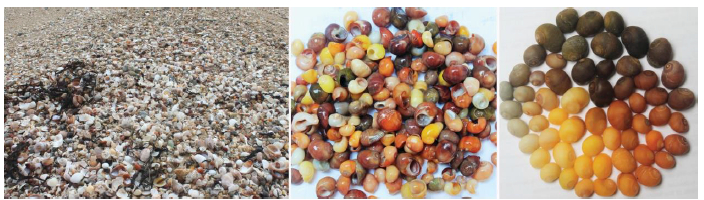
The small shells found by researchers that include California State University, Northridge anthropologist Hélène Rougier at La Roche-à-Pierrot, a prehistoric archaeological site in Saint-Césaire, France, date back more than 42,000 years, providing evidence of the oldest workshops for the manufacture of shell ornaments in that area.
Accompanied by red and yellow pigments, the “workshop” is associated to the Châtelperronian culture, which marks the transition between the last Neandertals and the arrival of Homo sapiens in Europe. The chronology and how this transition occurred has been the subject of heated debate for decades, Rougier said.
“The discovery of the shell ornament workshop, which we believe to be the oldest in Western Europe, tells us that either early modern humans made them or Neandertals made them, but if the latter hypothesis is correct, then Neandertals would have been influenced by modern humans,” Rougier said. “In either case, it means that early modern humans would have arrived in the region earlier than we thought.”
Rougier, who teaches in CSUN College of Social and Behavioral Sciences, has been working with researchers from around the world for more than a decade to explore prehistoric life in Europe, hoping to gain perspective on what human life was like before recorded history. The interdisciplinary approach provides an opportunity to bring new perspectives and raise questions that individuals in a particular specialty may not consider or be able to resolve.
The team’s latest findings, “Châtelperronian cultural diversity at its western limits: Shell beads and pigments from La Roche-à-Pierrot, Saint-Césaire,” appear in the Sept. 22, 2025 edition of the Proceedings of the National Academy of Sciences (PNAS), a peer reviewed journal of the National Academy of Sciences (NAS). The PNAS is an authoritative source of high-impact, original research that broadly spans the biological, physical, and social sciences.
In Europe, the period between approximately 55,000 and 42,000 years ago was marked by significant biological and cultural changes, notably the replacement of local Neandertal populations by groups of early modern humans arriving from Africa.
Once thought to be a rapid and uniform process, Rougier said, this demographic and cultural transition now appears to have been much more complex, marked by considerable variability in stone tool industries and the emergence of diverse forms of symbolic expression.
Rougier said ornamental shells, perforated and turned into beads, have been found elsewhere in Europe, usually around the Mediterranean, and were crafted to present some sort of cultural identity for the individual groups that crafted them.
“With this discovery in Western Europe,” she said, “it means that there may have been contacts between these different cultures, interactions, the sharing of information and of symbolic expression.
“The shell beads found elsewhere in Europe are usually around the Mediterranean in Southeastern Europe and the shell beads are made from shells of species that are local,” Rougier said. “What’s interesting is that the shell beads are made from species found in the Atlantic Ocean, not the Mediterranean. We were able to model where the coastline was at the time the shell beads were made, and the coastline was something like 130 kilometers, or about 80 miles, away.”
Rougier and her colleagues called what they found at La Roche-à-Pierrot a “workshop” because the large number of beads and bead fragments found at the site indicated that it had been used to manufacture the ornamental shell beads.
The fact that the shells worked on came from about 80 miles away raises more questions about how the shells were obtained, how they were transported to La Roche-à-Pierrot, why the beads were made and if they were used for more than ornamentation.
“Maybe they were made for looking pretty, as a symbolic expression or maybe as a sign of identification — I belong to this group and as soon as you see the ornamentation that I am wearing you know which group I belong to,” she said.
“As we do more research, we are starting to see plenty of different expressions among early Homo sapiens that we have seen only seldomly in some Neandertals before this time,” she continued. “The general audience often doesn’t imagine that people living 42,000 years ago had a sense of identity or individual collective identity, but our research shows that they did.”
Like this:
Like Loading...
Related






 Tweet This
 Facebook
 Digg This
 Bookmark
 Stumble
 RSS
RSS




REAL NAMES ONLY: All posters must use their real individual or business name. This applies equally to Twitter account holders who use a nickname.
0 Comments
You can be the first one to leave a comment.