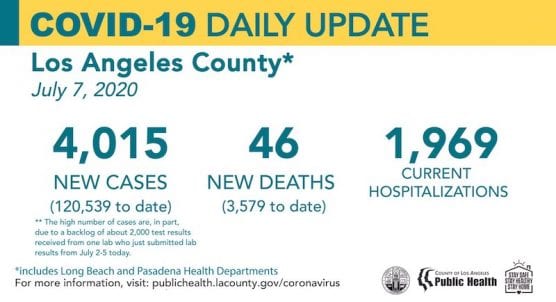
The Los Angeles County Department of Public Health confirmed Tuesday the highest number of new cases of COVID-19 reported in a day with 4,015 new cases and 46 new deaths. The high number of cases are, in part, due to a backlog of about 2,000 test results received from one lab that just submitted results from July 2 through July 5.
In Santa Clarita, Public Health has confirmed 3,425 cases to date.
Testing results are available for over 1,213,000 individuals with 9 percent of all people testing positive. The daily positivity rate (a composite of a 7-day rolling average) has risen to 11.6 percent.
To date, Public Health has identified 120,539 positive cases of COVID-19 across all areas of L.A. County, and a total of 3,579 deaths. Ninety-three percent of people who died had underlying health conditions.
There are 1,969 people currently hospitalized, 27% of these people are confirmed cases in the ICU and 18% are confirmed cases on ventilators. This remains substantially higher than the 1,350 to 1,450 daily hospitalizations seen three weeks ago. The number of daily of hospitalizations has steadily increased to over 1,900 since July 1.
According to Public Health records, of the 33 SCV residents who have died of the virus to date, 26 lived in the city of Santa Clarita, 2 in Acton, 2 in Castaic, 1 in Val Verde, 1 in unincorporated Valencia, and 1 in unincorporated Bouquet Canyon.
Statewide, as of July 6, the California Department of Public Health has confirmed a total of 277,774 cases and 6,448 deaths from COVID-19. Currently, there are 5,989 confirmed hospitalizations and 1,740 ICU hospitalizations. Numbers may not represent true day-over-day change as reporting of test results can be delayed.
California’s positivity rate – a key indicator of community spread – is trending upward in the 14-day average. Hospitalization rates are also trending upward in the 14-day average. There have been 4,896,370 tests conducted in California. As testing capacity continues to increase across the state, an increase in the number of positive cases has been expected – increasing the importance of positivity rates to find signs of community spread.
Health Care Worker Infection Rates
As of July 6, local health departments have reported 16,290 confirmed positive cases in health care workers and 94 deaths statewide.
Santa Clarita Valley Tuesday Update
Of the 3,425 cases reported to Public Health for the SCV to date, the community breakdown is as follows:
City of Santa Clarita: 1,386
Castaic: 1,805 (includes Pitchess Detention Center and North County Correctional Facility*)
Stevenson Ranch: 76
Canyon Country (unincorporated portion): 51
Val Verde: 34
Acton: 29
Agua Dulce: 15
Valencia (unincorporated portion west of I-5): 14
Saugus (unincorporated portion): 6
Elizabeth Lake: 4
Newhall (Unincorporated portion): 3
Bouquet Canyon: 1
Lake Hughes: 1
*Note: The county is unable to break out separate numbers for Castaic and PDC/NCCF because the county uses geotagging software that cannot be changed at this time, according to officials. Click here for the LASD COVID-19 dashboard.
Henry Mayo Tuesday Update
Henry Mayo Newhall Hospital reported its 14th COVID-related death on Wednesday, July 1, who died over the past weekend, according to hospital spokesman Patrick Moody.
The hospital is now releasing numbers on a weekly basis (Wednesdays) unless there is a drastic change in the number of cases or a death has been confirmed, Moody said.
As of Wednesday, July 1, (the day when numbers were last released) of the 3,273 persons tested at Henry Mayo to date, 349 tested positive, 3,214 were negative, 151 were pending and 19 patients were hospitalized in a dedicated unit receiving ICU-level care, six more than reported last Wednesday. A total of 110 COVID-19 patients have been discharged so far.
Discrepancies in the testing numbers are due to some patients being tested multiple times. “Often a single patient is tested more than once,” Moody said.
 L.A. County
“Every single person we have lost to COVID-19 was someone’s parent, sibling, friend and neighbor,” said Barbara Ferrer, PhD, MPH, MEd, Director of Public Health. “Our actions have consequences and they affect real people in our community. Choosing to not practice physical distancing or objecting to wearing cloth face coverings when around others can be a life-altering decision. Everyone shares the collective responsibility to slow the spread of COVID-19 to prevent an overwhelming surge of COVID-19 to save lives.”
Twenty-eight people who died were over the age of 65 years old, 10 people who died were between the ages of 41 and 65 years old, and five people who died were between the ages of 18 and 40 years old. Thirty-four people had underlying health conditions including 24 people over the age of 65 years old, 7 people between the ages of 41 to 65 years old, and three people between the ages of 18 and 40 years old. Two deaths were reported by the city of Long Beach and one death was reported by the city of Pasadena.
Of those who died, information about race and ethnicity is available for 3,327 people (99 percent of the cases reported by Public Health); 44% of deaths occurred among Latino/Latinx residents, 27% among White residents, 16% among Asian residents, 11% among African American/Black residents, less than 1% among Native Hawaiian/Pacific Islander residents and 1% among residents identifying with other races. Upon further investigation, 46 cases and one death reported earlier were not L.A County residents.
Public Health urges everyone to avoid the Three Cs: Crowded places, Confined spaces and Close contact with others not in your household. Everyone should always wear a face covering securely over your nose and mouth and keep six feet apart from others not in your household when out in public. Businesses must continue to follow Public Health directives. Public Health reminds everyone that you remain safer at home.
The Reopening Protocols, COVID-19 Surveillance Interactive Dashboard, Roadmap to Recovery, Recovery Dashboard, and additional things you can do to protect yourself, your family and your community are on the Public Health website, www.publichealth.lacounty.gov.

California Tuesday
As testing capacity continues to increase across the state, the California Department of Public Health is working to expand access to COVID-19 testing. Testing should be used for medical evaluation of persons with symptoms of COVID-19 as well as for efforts by public health agencies and essential employers to prevent and control the spread of COVID-19. Individuals prioritized for testing include:
– Hospitalized patients
– Symptomatic and asymptomatic healthcare workers, first responders, and other social service employees
– Symptomatic individuals age 65 and older or symptomatic individuals of any age with chronic medical conditions that increase the risk of severe COVID-19 illness
– Individuals who are tested as part of disease control efforts in high-risk settings
– Asymptomatic residents and employees of congregate living facilities when needed to prevent disease transmission
– Symptomatic and asymptomatic individuals in essential occupations such as grocery store and food supply workers, utility workers and public employees
– Other individuals with symptoms consistent with COVID-19
As of July 6, there have been 4,896,370 tests conducted in California and reported to the California Department of Public Health. This represents an increase of 103,017 tests over the prior 24-hour reporting period. These numbers include data from commercial, private and academic labs, including Quest, LabCorp, Kaiser, University of California and Stanford, and the the 25 state and county health labs currently testing.
Racial Demographics – A More Complete Picture
The California Department of Public Health is committed to health equity and collecting more detailed racial and ethnic data that will provide additional understanding for determining future action. Health outcomes are affected by forces including structural racism, poverty and the disproportionate prevalence of underlying conditions such as asthma and heart disease among Latinos and African American Californians. Only by looking at the full picture can we understand how to ensure the best outcomes for all Californians.
The differences in health outcomes related to COVID-19 are most stark in COVID-19 deaths. We have nearly complete data on race and ethnicity for COVID-19 deaths, and we are seeing the following trends. Overall, for adults 18 and older, Latinos, African Americans and Native Hawaiians and Pacific Islanders are dying at disproportionately higher levels. The proportion of COVID-19 deaths in African Americans is about double their population representation across all adult age categories. For Native Hawaiians and Pacific Islanders, overall numbers are low, but about three-fold difference between the proportion of COVID-19 deaths and their population representation. More males are dying from COVID-19 than females, in line with national trends. More information is available at COVID-19 Race and Ethnicity Data.
New Data Portal
The state has launched a new, user-friendly data portal at COVID-19 Statewide Update that tracks COVID-19 cases statewide and by county, gender, age and ethnicity. The portal also outlines statewide hospitalizations and testing efforts. The data presented on the portal will be updated daily and will include additional information as it is available.
Your Actions Save Lives
Every person has a role to play. Protecting yourself and your family comes down to common sense:
– Staying home except for essential needs/activities following local and state public health guidelines when patronizing approved businesses. To the extent that such sectors are re-opened, Californians may leave their homes to work at, patronize, or otherwise engage with those businesses, establishments or activities.
– Practicing social distancing.
– Wearing a cloth face mask when out in public.
– Washing hands with soap and water for a minimum of 20 seconds.
– Avoiding touching eyes, nose or mouth with unwashed hands.
– Covering a cough or sneeze with your sleeve, or disposable tissue. Wash your hands afterward.
– Avoiding close contact with people who are sick.
– Staying away from work, school or other people if you become sick with respiratory symptoms like fever and cough.
– Following guidance from public health officials.
Always check with trusted sources for the latest accurate information about novel coronavirus:
– Los Angeles County Department of Public Health
– California Department of Public Health
– Centers for Disease Control and Prevention
– Spanish
– World Health Organization
L.A. County residents can also call 2-1-1.
What to Do if You Think You’re Sick
Call ahead: If you are experiencing symptoms of COVID-19 (fever, cough or shortness of breath), call your health care provider before seeking medical care so that appropriate precautions can be taken. More than 85 community testing sites also offer free, confidential testing: Find a COVID-19 Testing Site.
For more information about what Californians can do to prevent the spread of COVID-19, visit Coronavirus (COVID-19) in California.
California continues to issue guidance on preparing and protecting California from COVID-19. Consolidated guidance is available on the California Department of Public Health’s Guidance webpage.
Like this:
Like Loading...
Related



 Tweet This
 Facebook
 Digg This
 Bookmark
 Stumble
 RSS
RSS




REAL NAMES ONLY: All posters must use their real individual or business name. This applies equally to Twitter account holders who use a nickname.
0 Comments
You can be the first one to leave a comment.