How can California State University, Northridge student athletes enhance their performances? Learning how to get a good night’s sleep may be the answer. A team of CSUN students is conducting research to find out.
By studying a diverse range of athletes and tracking their sleep patterns, the researchers are hoping to discover ways to improve the athletes’ quality of rest.
“The Boracle project was proposed by Dr. Nhut Ho, the Director of the Autonomy Research Center for STEAHM and professor in the Department of Mechanical Engineering at CSUN. I am co-leading the Boracle project with Dr. Ho and external collaborators from industry and academia. The reason we want to look into these topics is because we have had conversations with the coaches and trainers in the athletic department at CSUN,” said Xunfei Jiang, an associate professor in the Department of Computer Science in CSUN’s Andrew J. Anagnost College of Engineering and Computer Science. “They’re interested in how to use data to understand the performance of athletic students, and if we can analyze their sleep quality to understand how sleep will affect the performance of the students and injury prediction and recovery.
“Back in 2023, we had conversations with 19 student athletes from 11 different sports teams. We learned what metric data and information they were interested in and what data needed to be gathered.”
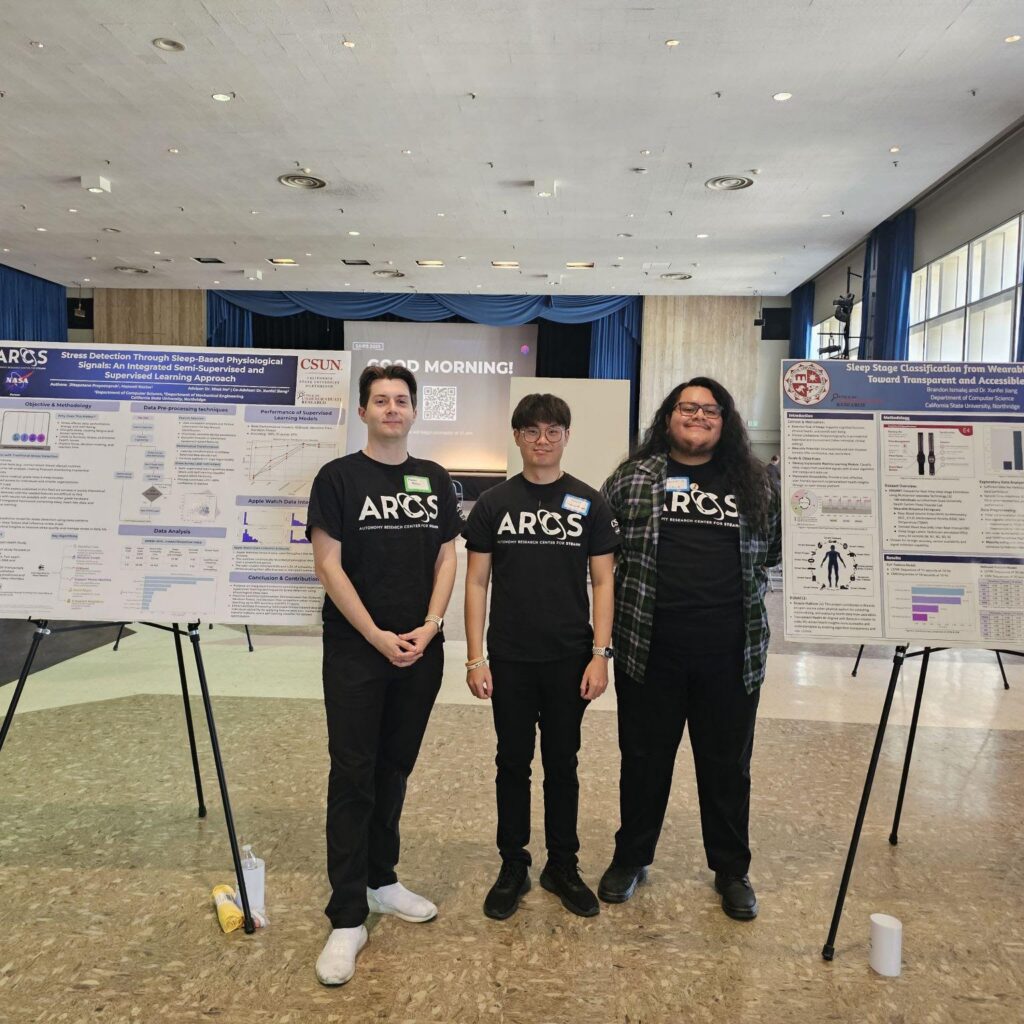
Computer science student Brandon Ismalej leads the Intelligent Algorithms (IA) team of seven to nine undergraduate and graduate students throughout the school year to work on different research topics. Their current efforts include stress detection, activity recognition and injury prediction and analysis in student athletes.
The research team members wear special devices that track their sleeping patterns and enable sleep stage classification for the researchers. The goal is to identify ways to apply the data and assess its accuracy, Ismalej said.
“Being able to actually use data collected throughout the night, we found that we can look into how stressed a person is,” he said. “The main marker that we’ve identified across all of our work is the variability of your heart rate. It tells us a lot about how stressed you are, or likelihood of injury in future training sessions if you’re an athlete. That’s been the main marker that we’re really trying to link to more. It reveals a lot about not just these smaller metrics, but also more broadly about other areas that we can explore down the line.”
Ismalej, who has been part of the research team since its inception in 2024, found small indicators of what affects sleep quality during the project. One shows how stress can impact one’s heart rate while sleeping, which may also be a factor in an athlete’s likelihood of injury.
Within the Boracle project are multiple subteams focusing on different areas, including building a data platform for smart wearable device data collection and storage, developing a marketplace web application for users to search for smart wearable devices and corresponding applications, and conducting data collection and performing data analysis using intelligent algorithms.
The students in the IA sub-team presented their research at CSUNPosium, a SoCal AI research summit at the University of California, Los Angeles. Jittapatana (Patrick) Prayoonpruk and Maxwell Kozlov’s poster on stress detection won first place in a poster session group in the CSUNposium. The group’s research papers were accepted for publication, and students in the group presented their work to professionals at international research conferences (such as IEEE FDMS and IEEE CCWC). Abhinav Neelam’s paper had won the best paper award in the session of “ARTIFICIAL INTELLIGENCE AND MACHINE LEARNING” in IEEE CCWC 2026 conference.
Using public datasets and data collected from the IA subteam members, the LSTM model in the sleep quality analysis project achieved an accuracy of 93%, which demonstrated high performance in detecting wake and REM stages. The model in the stress detection project demonstrates a 99% accuracy in detecting stress from physiological signals during sleep. To learn more about this project, visit https://www.ecs.csun.edu/dsr/stress_detection.html
The team is recently planning to get athlete students involved in data collection activities. “We are collaborating with the Athletic Department to submit the IRB application, and after that we plan to collect data from a broad range of athletic students,” Dr. Jiang said.
CSUN has a Data Science Research Group that applies data science to real-world projects and works towards discovering advancements in areas such as climate change, human health, energy-efficient computing, and more.
Like this:
Like Loading...
Related





 Tweet This
 Facebook
 Digg This
 Bookmark
 Stumble
 RSS
RSS




REAL NAMES ONLY: All posters must use their real individual or business name. This applies equally to Twitter account holders who use a nickname.
0 Comments
You can be the first one to leave a comment.