The study of bones from the largest collection of Neandertal remains in Northern Europe has revealed evidence of selective cannibalism targeting Neandertal females and children between 41,000 and 45,000 years ago.
The non-local origins of these Neandertal females and children points to the possible existence of tensions or conflicts between human groups in Northern Europe at the end of the Middle Paleolithic — a period and region marked by growing cultural and biological diversity, said California State University, Northridge anthropologist Hélène Rougier.
Rougier, who teaches in the College of Social and Behavioral Sciences, noted that the bones bear numerous cutmarks, fracturing traces and even traces of use as tools.
“The clues indicate intense cannibalistic activity,” she said. “Moreover, the observation that Neandertals were treated similarly to the animals found at the site suggests a nutritional form of cannibalism practiced by the site’s occupants.”
The study, “Highly selective cannibalism in the Late Pleistocene of Northern Europe reveals Neandertals were targeted prey,” appeared in the journal Scientific Reports.
The remains are part of a 21-drawer collection of bones, many of them in fragments, excavated from the Goyet cave in Belgium discovered in the 19th century and stored at the Royal Belgian Institute of Natural Sciences. Rougier has been studying the collection for more than a decade, carefully piecing together often minuscule pieces of bone, looking for clues of what life was like in Northern Europe tens of thousands of years ago.
She is part of a team of researchers who take an interdisciplinary approach — combining paleogenetics, isotope analysis and detailed morphological study — to provide, for the first time, a clear biological portrait of the cannibalized individuals.
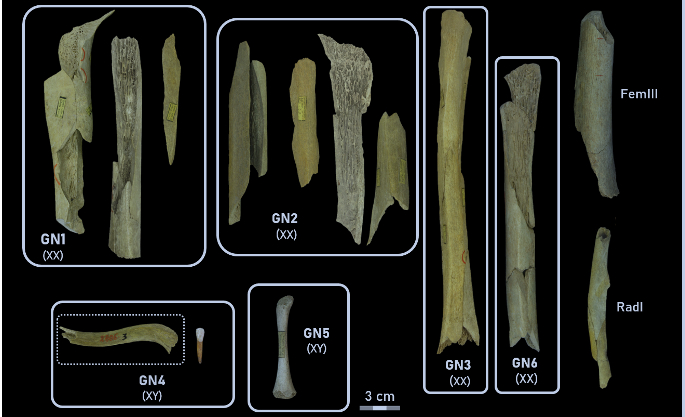
The researchers identified a minimum of six individuals: four adult or adolescent females and two children, including an infant. Sulfur isotope analysis showed that the individuals were not from the local region, suggesting exocannibalism — the consumption of individuals belonging to one or several other groups.
“Basically, we compared their isotopes to those of the animal bones that were there, notably animals that would have lived in the vicinity and would have been hunted there, and possibly butchered there in the cave,” Rougier said. “We saw that they were different. The animals had not come from the same environment as the individuals whose bones we examined.
“All we can say is that they were not from there,” she said. “They could have come from a different valley from the one the cave is located in, or from much further away. We don’t know. But what we do know is that they were most probably not the inhabitants of this cave.
“When you piece this together with the idea that it’s not a sample that is normal in terms of representation of individuals — four females and two kids rather than a mix of males and females — that tells you their presence in the cave was intentional,” she added. “If you take six Neandertals randomly from a group, what are your chances of having four females and two kids?”
An examination of the internal structure of the fragmented long bones indicated very low robustness of the tibias and femurs of the cannibalized females compared to other Neandertals. Combined with their short stature (about 4.9 feet on average), this supports the hypothesis that the owners of the bones were specifically targeted, Rougier said.
“These Neandertal females and children were brought to the site and consumed by another group,” Rougier said, noting that in intergroup conflict, one group often targets the weakest and most vulnerable from another to assert territorial control or, when females are targeted, to weaken their reproductive capabilities.
“Ethnoarchaeological parallels also show cannibalism linked to intergroup conflicts,” she said. “In a context marked by the decline of Neandertals and the arrival of Homo sapiens in Northern Europe, the Goyet site provides crucial insight into possible intergroup violence at the end of the Middle Paleolithic.”
Like this:
Like Loading...
Related





 Tweet This
 Facebook
 Digg This
 Bookmark
 Stumble
 RSS
RSS




REAL NAMES ONLY: All posters must use their real individual or business name. This applies equally to Twitter account holders who use a nickname.
0 Comments
You can be the first one to leave a comment.