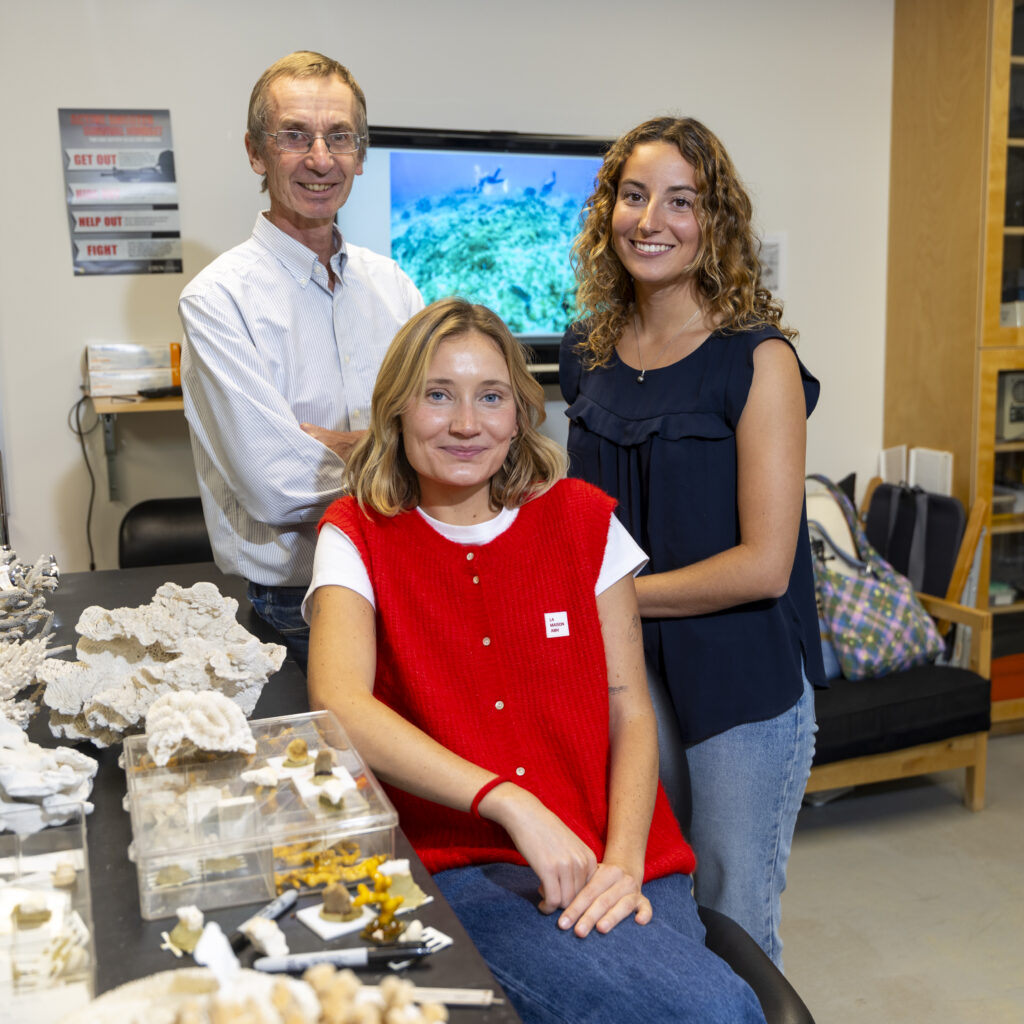
A landmark study led by two California State University, Northridge graduate students has revealed that recent heat waves, which caused the mass mortality of fire corals, contributed to the widespread elimination of the last standing coral flourishing in St. John, U.S. Virgin Islands, marking a turning point in the ecology of shallow coral reefs in the region.
The research, titled “Marine heatwave decimates fire coral populations in the Caribbean”, was conducted by biology graduate students Emilia Dell’Antonio and Lauren Mahoney and appears in the latest edition of the Proceedings of the National Academy of Sciences (PNAS), a peer reviewed journal of the National Academy of Sciences (NAS). PNAS is one of the world’s leading science journals and is an authoritative source of high-impact, original research that broadly spans the biological, physical, and social sciences.
Their work is part of an ongoing 39-year study in the U.S. Virgin Islands by CSUN marine biologist Peter Edmunds, who has been studying corals and the reefs they build for five decades. Edmunds, who teaches in CSUN’s College of Science and Mathematics has ongoing long-term projects in St. John and Mo’orea, French Polynesia.
“These kinds of studies are the new gold standard for marine ecology and they are the only means by which we know how our planet is changing,” Edmunds said. “Long-term ecological studies occur through the commitment and hard work of scientists at multiple stages of their careers, and Emilia and Lauren are exactly the kind of early-career scientists that are required to carry this work forward.”
Edmund’s long-term work highlighted how hurricanes, coral bleaching and disease outbreaks over the last four decades have caused populations of most species of corals to decrease and reach extremely low levels in St. John. However, fire corals have adaptations that have made them able to withstand these same disturbances, until 2024, when 84% of fire corals in St. John succumbed to the hottest heatwave recorded in 36 years.
The death of the fire coral will have profound impacts on the coral reef ecosystem as there are very few corals left to build calcium carbonate skeletal structures that create habitat and protection for other reef creatures, according to Dell’Antonio.
“This type of research is important because it contextualizes a noteworthy event into nearly four decades of ecological monitoring,” Dell’Antonio said. “The most important lesson we have learned from this event is that even species that are successful in the short-term (called ‘ecological winners’) can and probably will succumb to the effects of increasingly severe disturbances.
“This points to an uncertain future for coral reefs and emphasizes the importance of global mitigation strategies and local adaptations for coral reef conservation,”she said.
The critical research shows the importance of long-term monitoring to identify significant changes, as well as demonstrating how student-led research can advance science, Mahoney said.
The grad students spent three months in the field over two years collecting data for this project.
“These long-term field efforts demonstrate the value of consistency and continuity in ecological research. Every year of monitoring builds on the last, allowing us to detect when changes like this are not just another disturbance but an ecological anomaly,” Mahoney said. “Equally important, this study highlights how research programs can empower student-led discovery, showing that the work of graduate students is both impactful and essential to advancing science.
“As an early-career scientist, it’s incredibly exciting to see your hard work come to fruition,” she said. “When you first start out, publishing your research can feel like an unattainable goal, especially in a journal like PNAS, but this experience shows that it’s absolutely possible.”
This research was made possible due to funding from two National Science Foundation grants, one that supports the annual monitoring projects conducted on the shallow reefs in St. John and another for interdisciplinary exploratory research in which the students worked with a team of engineers from Woods Hole Oceanographic Institution.
“This project allowed our team to conduct additional fieldwork in St. John for two years and allowed us to capture the ecological surprise of the 2023/24 marine heatwave with increased detail while also focusing on our collaboration,” Dell’Antonio said.
Edmunds credited CSUN with giving both students the platform and opportunity to pursue such an ambitious research project that will have a long-term impact on the science community.
“CSUN provides unique educational and research opportunities that attract some of the best young scientists in America,” Edmunds said. “Publishing their work in one of the best scientific journals provides well-justified recognition of the quality of our students, the reputation of CSUN, and the ability of the CSUN science community to work at the highest level”.
Like this:
Like Loading...
Related





 Tweet This
 Facebook
 Digg This
 Bookmark
 Stumble
 RSS
RSS























REAL NAMES ONLY: All posters must use their real individual or business name. This applies equally to Twitter account holders who use a nickname.
0 Comments
You can be the first one to leave a comment.