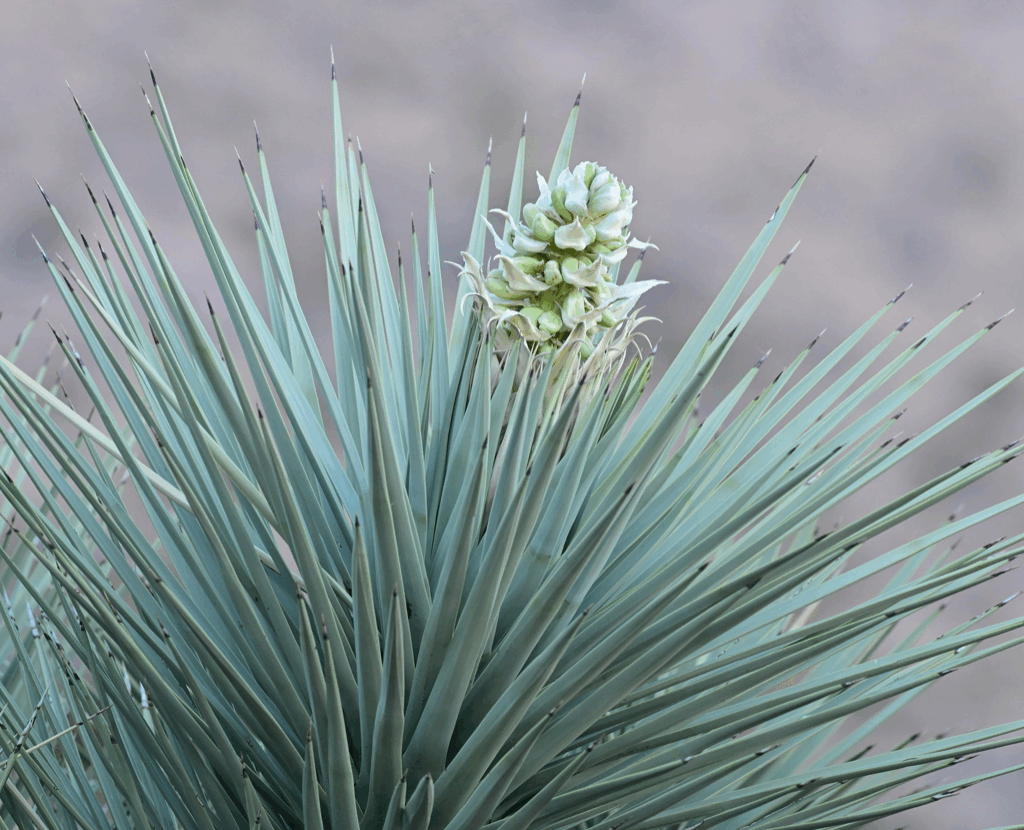
Southern California’s iconic Joshua trees are in bloom, and California State University, Northridge’s environmental biologists are asking the public’s help in figuring out why and what it means for the trees’ future.
Associate professor of biology Jeremy Yoder and graduate student Kirsten Zornado are asking members of the public to capture photos of the out-of-season bloom and upload them onto the smartphone app iNaturalist.
“From what we can tell so far, this ‘bonus bloom’ has been going on since about mid-November,” Zornado said. “The assumption is that it’s associated with the rain that came through in November. But we don’t know that for sure. That’s one of the reasons we’re asking people to help us collect the data.”
The normal flowering season for Joshua trees starts in late February into April. They usually flower for a couple weeks and then start to develop fruit, if the plant is pollinated by yucca moths, the only insects that can successfully pollinate Joshua trees.
“But yucca months aren’t around this time of the year, because there usually aren’t Joshua tree flowers available for them,” Yoder said. The moths typically spend the time between flowering seasons in a kind of hibernation state, burrowed into the desert soil, and they emerge when the trees flower. “We have relatively little information about how the moths know when to come up and pollinate the plants. One of the things we’re pretty sure they use to know that a year has passed is that they experience winter cold. But if the trees are flowering months earlier than normal because of a big late season rainfall event, there may not have been the cue they need to know that the flowering season has begun.”
The fruit generated by the pollinating yucca moths are essential for Joshua tree survival. The seeds from the fruit grow into the next generation of Joshua trees. No seeds, no new trees.
“If the weird weather makes the Joshua trees flower, but it doesn’t cue the moths to come to pollinate those flowers, then the flowers will be wasted,” said Yoder, who teaches in CSUN’s College of Science and Mathematics.
Zornado said the researchers want the public to help them answer the questions surrounding what prompted the “bonus bloom” and what happens when the flowers start to disappear.
“We want to get a really good snapshot of where the flowering is occurring right now for a couple of reasons,” she said. “First of all, we have thorough weather data for pretty much everywhere in this day and age. So, we can look at the current flowering event, look at the data six months later when it’s over, look at the weather that occurred around this time and see if we can draw any patterns from where the flowering occurred and where the intense rainfall occurred to see if our hypothesis, that the really intense rain caused the flowering, is correct.”
The data collected will also help them test their hypothesis that the moths won’t be coming out in January to pollinate the Joshua trees because it’s too cold.
“We want to see not only where the flowers are occurring, what the weather was like and also if those flowers are resulting in any fruit,” Zornado said.
Those willing to help the researchers collect information on Joshua trees, they can visit the website for Yoder’s Lab where they can learn more about the research project, find instructions for downloading the iNaturalist app and how to participate in the project.
Like this:
Like Loading...
Related





 Tweet This
 Facebook
 Digg This
 Bookmark
 Stumble
 RSS
RSS
























REAL NAMES ONLY: All posters must use their real individual or business name. This applies equally to Twitter account holders who use a nickname.
0 Comments
You can be the first one to leave a comment.